Your 30-year manufacturer warranty is a fairy tale that won’t survive a single Broward County summer. In Florida, the real answer to how often to replace roof isn’t found on a product label. It’s found in your mailbox when your insurance company threatens non-renewal. You’re tired of the high-pressure sales pitches. You’re fed up with the fear of hidden leaks. You’re done with the industry games. We get it. You want the blunt truth without the corporate spin.
At Renegade Roofing Co., we’re built for the storms. We hold roofing license #CCC1328895 and general contractor license #CGC1514572 because we own every outcome. This guide breaks down the hard reality of the 2026 insurance laws and SB 808. We’ll show you the actual lifespans for shingle, tile, and metal in our brutal climate. You’ll know exactly when to pull the trigger on storm damage restoration and when you can actually pass a 15-year inspection. Whether you’re in Deerfield Beach or Palm Beach County, call us at 954-336-8538 for the straight talk. No shortcuts. Ever.
Key Takeaways
- Stop trusting marketing brochures; learn how Florida’s sun and 2026 insurance regulations dictate how often to replace roof regardless of what the manufacturer promised.
- Identify the specific red flags—like granule loss in your gutters or “fish-mouthing” shingles—that signal your roof is failing before a summer storm hits.
- Understand how the new July 2026 laws (SB 808) affect homes in Broward and Palm Beach County, potentially saving you from a forced replacement through a professional inspection.
- Learn why an honest assessment from a local expert who “knows better, does better” is worth more than a high-pressure pitch from a salesman.
- Get the hard truth on the “Florida Factor” that subtracts 25% from any national lifespan estimate for shingle, tile, and metal materials.
How Long Should Your Roof Actually Last? (The No-BS Breakdown)
Most roofing companies sell you a 30-year dream. It’s a lie. In South Florida, that piece of paper is just marketing fluff designed to close a sale. The sun, the humidity, and the relentless pressure of hurricane season don’t care about a manufacturer’s promise. If you want the truth about how often to replace roof, you have to look at the local reality. We don’t hide behind fine print. We give it to you straight.
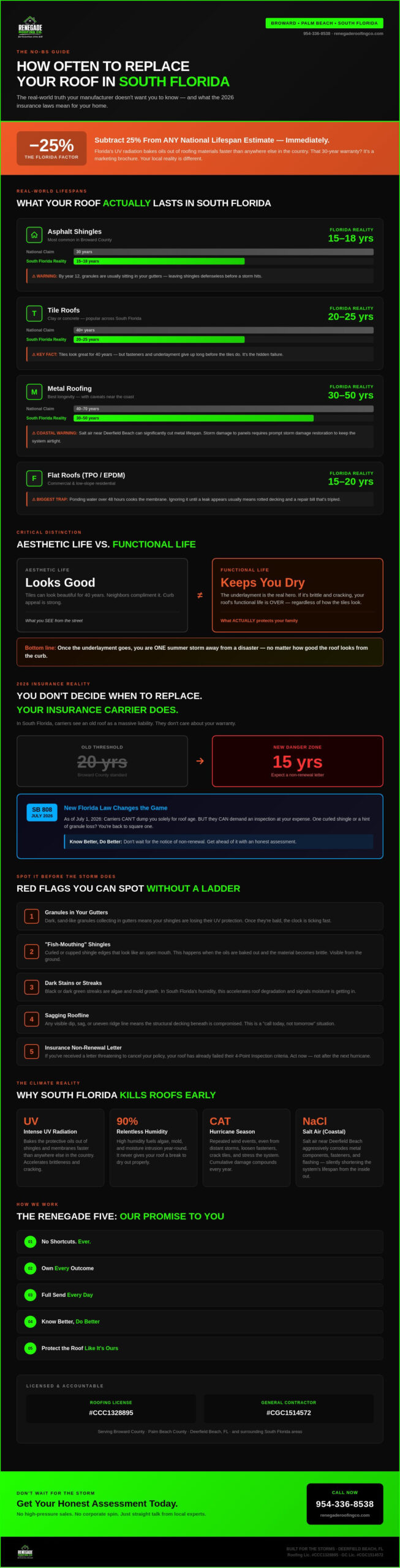
We use what we call the “Florida Factor.” Take any national lifespan estimate you find online and subtract 25% immediately. That is your real-world window. The intense UV radiation here bakes the oils out of your materials faster than anywhere else in the country. We’ve seen roofs that look “fine” from the curb but are completely failing underneath. At Renegade Roofing Co., we protect the roof like it’s ours, which means telling you the hard truth about your home’s actual protection. Waiting until a leak starts is a gamble you’ll eventually lose.
The real hero, or the villain, of your story is the underlayment. While roofing materials and design vary wildly, the waterproof barrier beneath the surface is what actually keeps your family dry. We distinguish between “Aesthetic Life” and “Functional Life.” Your tiles might look beautiful for 40 years, but if the underlayment is brittle and cracking, the functional life of that roof is over. Once that barrier goes, you’re one summer storm away from a disaster. Know better, do better.
Shingle, Tile, and Metal: The Real Numbers
- Asphalt Shingles: National sites claim 30 years. In Broward County, 15 to 18 years is the local reality. By year 12, the granules are usually sitting in your gutters, leaving your shingles defenseless.
- Tile Roofs: Expect 20 to 25 years. The clay or concrete tiles are tough, but the fasteners and underlayment will give up long before the tiles do.
- Metal Roofing: These can go 30 to 50 years. However, if you live near the salt air in Deerfield Beach, that lifespan can drop significantly. If a major storm rattles the panels, you might need storm damage restoration to keep the system airtight.
Flat Roofs and Commercial Systems
Flat roofs in Palm Beach County face a unique enemy: ponding water. When water sits on a roof for more than 48 hours, it starts cooking the membrane like an oven. For TPO and EPDM systems, you should expect 15 to 20 years if you stay on top of maintenance. Business owners often fall into the “out of sight, out of mind” trap. Ignoring a flat roof until it leaks usually means the decking is already rotted and the repair bill has tripled. We own every outcome, and that starts with an honest assessment. If you’re unsure where your roof stands, call us at 954-336-8538. We hold roofing license #CCC1328895 and general contractor license #CGC1514572 to ensure your property is built for the storms.
The Florida Insurance Factor: Why 20 Years is the New 30
You might think you decide how often to replace roof. You’re wrong. In South Florida, your insurance carrier holds the cards. They see an old roof as a massive liability. They don’t care about your 30-year warranty. They care about their risk. In Broward County, 20 years used to be the standard. Now? 15 years is the danger zone. Carriers are dropping policies faster than a summer downpour. They use the 4-Point Inspection to find any excuse to force your hand. If your shingles are 15 years old, expect a letter. It isn’t a suggestion. It’s an ultimatum. You either replace it, or you lose your coverage.
The legal landscape changed significantly with Florida Senate Bill 4-D. This law revamped the 25% rule and tightened the screws on older structures. As of July 1, 2026, new regulations mean carriers can’t dump you solely for the age of your roof. However, they can demand an inspection at your expense. If that inspector finds one curled shingle or a hint of granule loss, you’re back to square one. We’ve seen homeowners in Palm Beach County lose their coverage over minor issues because their roof was “too old” on paper. Don’t wait for the notice of non-renewal. If you’re worried about your policy, it’s time for an honest assessment of your roof’s condition.
The 15-Year Shingle Rule
Asphalt shingles are the primary target for insurance scrutiny. At 15 years, the oils are usually baked out. The shingles become brittle. If you try to “repair” a 16-year-old roof, you’re throwing good money after bad. One repair often leads to more damage because the surrounding shingles are too stiff to lift. It’s a trap. We tell our neighbors in Deerfield Beach the truth: sometimes a full replacement is the only way to keep your home insurable. We own every outcome, and that means being honest when a patch job won’t cut it.
Tile Roofs and the Underlayment Trap
Tile roofs are deceptive. The concrete or clay looks perfect from the street. But the underlayment underneath is a different story. After 20 years in the Florida heat, that paper turns to dust. Insurance companies know this. They won’t cover a 20-year-old tile roof because they know the “Functional Life” is over. A “lift and reset” might sound cheaper, but it often costs nearly as much as a new roof with none of the insurance benefits. We protect the roof like it’s ours. We won’t sell you a band-aid for a wound that needs stitches. If you suspect you need storm damage restoration, call us at 954-336-8538. We hold roofing license #CCC1328895 and general contractor license #CGC1514572. We’re here to keep you covered.
Red Flags You Can Spot Without a Ladder
You don’t need to risk your neck on a ladder to know your roof is failing. Your home is already telling you the truth. When people ask how often to replace roof, they’re usually looking for a date on a calendar. Forget the calendar. Look at the ground. If you see shingles or “sand” in your driveway after a rain, the clock has already run out. Waiting for a major leak in the middle of a South Florida hurricane is a recipe for disaster. It’s the difference between a controlled replacement and an emergency storm damage restoration that costs twice as much. Inaction is the most expensive mistake you can make.
Granule loss is the most obvious sign. Check your gutter downspouts. If they look like a beach, those shingles are dying. Those granules are the only thing protecting the asphalt from our brutal UV rays. Once they’re gone, the shingles turn into brittle charcoal. You might also see “fish-mouthing.” This is when shingles curl up at the edges because of intense attic heat. It makes your roof look like a series of open mouths. These curled edges catch the wind like a sail. In a 70 mph gust, they’ll peel off like paper. If your shingles look like old potato chips, they’ve lost their ability to protect your home.
Stand back at the curb and look for the “Shadow Effect.” If the lines of your roof look wavy or you see visible dips, you have structural sagging. This usually means the plywood decking underneath is rotting or delaminating. It isn’t just an aesthetic issue. It’s a safety hazard. We own every outcome, and we don’t ignore these structural warnings. We protect the roof like it’s ours; that means telling you when the bones of your house are at risk. No shortcuts. Ever.
Signs of Interior Water Damage
Don’t wait for a drip on your forehead. Look for yellowing or bubbling paint on your ceilings. If you see dark spots or mold in the corner of your attic, you have a “replace now” emergency. Mold doesn’t just eat your house; it threatens your family’s health. Also, watch your electric bill. If your AC is struggling more than usual, your roof ventilation might be failing. A “baked” roof traps heat, forcing your AC to work overtime. Know better, do better.
Exterior Warning Signs for Metal and Tile
Metal roofs aren’t invincible. Rust streaks on the panels mean the protective coating is gone. Once rust starts, it’s the beginning of the end for that system. For tile, missing or slipped pieces are a gateway for downpours. Remember, the tile is just the shield. The underlayment is the actual waterproof barrier. If the shield is broken, the barrier is being shredded by the sun and rain. Check the flashing around your chimney and vents. Loose or cracked flashing is the #1 source of leaks in Broward and Palm Beach County. If your roof is showing these signs, call Renegade Roofing Co. at 954-336-8538. We hold roofing license #CCC1328895 and general contractor license #CGC1514572. We’re based in Deerfield Beach and we’re built for the storms.
Why the South Florida Climate Kills Roofs Early
The Florida sun is a slow-motion arsonist. It doesn’t just heat your home; it chemically dismantles your roof. When you ask how often to replace roof, you’re really asking how long your materials can survive a relentless assault of UV radiation and thermal shock. In Broward County, the “service life” of a roof is often much shorter than its “hurricane-ready life.” A roof that stays dry during a drizzle might still disintegrate during a tropical storm. We don’t build for the sunny days. We build for the worst days.
UV radiation is the silent killer. Asphalt shingles rely on petroleum-based oils to stay flexible. The Florida sun bakes those oils out, leaving the shingles brittle and prone to cracking. Then comes thermal shock. Imagine your roof sitting at 120 degrees all afternoon. Suddenly, a typical South Florida downpour hits, dropping the temperature by 30 degrees in minutes. The materials contract violently. This constant expansion and contraction creates micro-fissures in your shingles, tiles, and metal panels. Over time, these cracks become the primary entry points for water. If you live within five miles of the coast in Deerfield Beach, salt air corrosion adds another layer of destruction, eating through fasteners and metal flashings before you even notice a problem.
Hurricane stress is the final blow. Even “near misses” that don’t cause visible damage can weaken your roof’s integrity. Sustained high winds create a vacuum effect that pulls at your shingles and vibrates your fastener system. Every time your roof “chatters” in the wind, the nails loosen just a fraction. After a few seasons of this, your roof is no longer a shield. It’s just a collection of loose parts waiting for a reason to fly away. We own every outcome, which means we look for these hidden weaknesses that other guys ignore. No shortcuts. Ever.
The Impact of Humidity and Mold
Florida humidity turns a tiny pinhole leak into structural rot in weeks, not years. If you see black streaks on your roof, it isn’t dirt. It’s Gloeocapsa Magma, a hardy algae that feeds on the limestone filler in your shingles. This algae holds onto moisture, keeping your roof damp and accelerating rot. Without proper ventilation, your attic becomes a pressure cooker, baking your roof from the inside out. We protect the roof like it’s ours by ensuring your ventilation system actually works.
Storm Prep: Is Your Roof “Hurricane Ready”?
There is a massive difference between a waterproof roof and a wind-rated roof. An old roof might keep the rain out today, but its fasteners are likely fatigued. At Renegade Roofing Co., our take is simple: if your shingle roof is over 15 years old, it’s a liability. By 20 years, it’s a gamble you shouldn’t take with your family’s safety. We hold roofing license #CCC1328895 and general contractor license #CGC1514572 because we understand the total structural needs of your home. Don’t wait for the next named storm to find out your roof is failing. Reach out for a professional inspection to verify your roof’s wind resistance. You can also call us directly at 954-336-8538 to speak with a local expert who knows better and does better for South Florida homeowners.
Getting an Honest Assessment (The Renegade Way)
Most roofing companies are just sales machines in a truck. They see a single missing shingle and try to sell you a whole new system before the sun goes down. We don’t play those games. At Renegade Roofing Co., we tell homeowners “not yet” more often than you would think. If your roof has three to five years of functional life left, we will give you the straight talk. We want to be the team you trust for the next two decades, not just the guys who cashed a check today. We protect the roof like it is ours. That means we don’t take shortcuts. Ever.
The difference between a salesman and an expert is accountability. A salesman disappears once the shingles are on the ground. We stay anchored to our community in Deerfield Beach. We back our work with a 10-year workmanship warranty because we own every outcome. We know that a roof replacement is a massive investment. That is why we offer financing options as low as $99 a month. We want to provide peace of mind without the financial gut-punch. You deserve a roof that is built for the storms, installed by locals who actually care about your safety.
Repair vs. Replace: Making the Financial Call
In Florida, the “25% Rule” is the law of the land. If the cost of your repairs exceeds 25% of the cost of a full replacement, the building code requires the entire roof to be brought up to current standards. Many shady contractors will lowball a repair quote just to get their foot in the door, only to hit you with “unforeseen” costs later. Cheap roofing is the most expensive mistake you will ever make. A “budget” roof in Broward or Palm Beach County will fail during the first real tropical system. When evaluating how often to replace roof, look at the total value, not just the bottom line. We provide transparent quotes that cover everything from the decking to the final flashing. No hidden fees. No BS.
Next Steps for Broward and Palm Beach Homeowners
If you are tired of the runaround, it is time for a professional assessment. We serve Broward County, Palm Beach County, and the surrounding South Florida areas with a “Full Send Every Day” attitude. When you schedule an inspection with us, you get a seasoned expert who knows better and does better. We will walk your roof, check your attic, and give you a definitive timeline for your specific material. Stop guessing and get the straight talk on your roof today.
Don’t wait for the next storm damage restoration project to land in your lap. Call Renegade Roofing Co. at 954-336-8538. We hold roofing license #CCC1328895 and general contractor license #CGC1514572. We are ready to show you what an honest, local roofing partner looks like.
Stop Guessing and Start Protecting Your Home
You’ve seen the red flags. You know the insurance companies are tightening the screws. The hard truth about how often to replace roof in Broward or Palm Beach County isn’t found in a generic online guide. It’s dictated by the 2026 laws and the brutal UV rays baking your shingles today. Waiting for a major storm to force your hand is a losing strategy. It leads to mold, structural rot, and emergency expenses that could have been avoided. Inaction is the most expensive mistake you can make.
We bring 20+ years of South Florida expertise to every job. We back our work with a 10-year workmanship warranty because we own every outcome. With financing starting at $99/mo, you don’t have to choose between your savings and your safety. We hold roofing license #CCC1328895 and general contractor license #CGC1514572 to ensure your home is built for the storms. You’ve been burned by bad contractors before; we’re here to be the local experts who finally tell you the truth.
Don’t let another hurricane season pass with a question mark over your head. Let’s get your home protected properly.
Common Questions About Florida Roof Lifespans
Is a 20-year-old roof too old in Florida?
A 20-year-old roof is a liability. Period. Even if you don’t see water dripping from your ceiling, the internal components are likely toast. The underlayment is brittle. The fasteners are fatigued. In our climate, 20 years is the absolute limit for most systems before they stop being a shield and start being a gamble. Insurance companies know this and will usually demand a replacement regardless of how it looks from the curb.
Can I get insurance on a 15-year-old shingle roof?
You can, but it is a battle. As of July 1, 2026, Florida law (SB 808) prevents carriers from denying coverage solely based on age for roofs under 15 years. If your shingles are older, you will need a professional inspection to prove the roof has at least five years of useful life remaining. Without that certificate, expect a non-renewal notice in your mailbox. It is the new reality of how often to replace roof in the Sunshine State.
How much does it cost to replace a roof in Broward County?
Market data shows that asphalt shingle replacements for a standard 2,000 sq ft home in Broward County typically range from $9,500 to $16,000. This is higher than national averages because we live in a High-Velocity Hurricane Zone (HVHZ). Stricter building codes and better materials are required here. If you opt for tile or metal, those market costs can easily double or triple depending on the complexity of your home’s structure.
What is the best roofing material for South Florida heat?
Metal roofing is the heavyweight champion for heat resistance. It reflects UV radiation instead of absorbing it like a sponge. Concrete or clay tile is a solid runner-up because the material creates a natural thermal barrier. Both options keep your attic cooler and take the strain off your AC unit. While shingles are cheaper upfront, they bake in the sun and fail much faster than premium materials. If you want the full breakdown on how these two options stack up in our climate, read our metal roof vs shingles comparison for South Florida homeowners.
Does a new roof increase home value in Florida?
How long does a tile roof last in Florida before needing a new underlayment?
Expect 20 to 25 years. The tiles themselves are tough and can last 50 years, but the waterproof underlayment beneath them is the weak link. Once that paper becomes brittle and cracks, the tiles are just for show. If you wait until you see a leak, you are likely looking at a massive storm damage restoration project instead of a simple maintenance job. Know better, do better.
Can I replace my own roof shingles?
Don’t even think about it. Florida building codes are the strictest in the country. You can’t pull the required permits without a license, and your insurance company will laugh at your policy if they find out the work wasn’t done by a pro. One mistake with a flashing or a nail pattern will void your coverage and leave you vulnerable during the next hurricane. It is a shortcut that will cost you everything. If you’re dealing with an active leak right now, learn what proper asphalt shingle roof leak repair in Florida actually looks like before you make a costly mistake.
What happens if I don’t replace my roof when the insurance company asks?
They will drop your policy. If you have a mortgage, your lender will then hit you with “force-placed” insurance. This is a nightmare scenario. Force-placed insurance often costs three times more than a standard policy and usually only protects the lender’s interest, not your belongings or your equity. It is a financial trap that is much more expensive than just doing the job right the first time. Before you decide between metal roof vs shingles for your replacement, call Renegade Roofing Co. at 954-336-8538 for an honest assessment before you get backed into a corner. We hold roofing license #CCC1328895 and general contractor license #CGC1514572 because we own every outcome.